


A handheld VHF radio is essential safety equipment for any boater. Whether you’re coastal sailing, fishing offshore or enjoying watersports, a reliable VHF lets you communicate with other vessels, harbours and emergency services when it matters most. This guide explains the key features, realistic range expectations and how to choose the right handheld VHF for your specific boating activities.
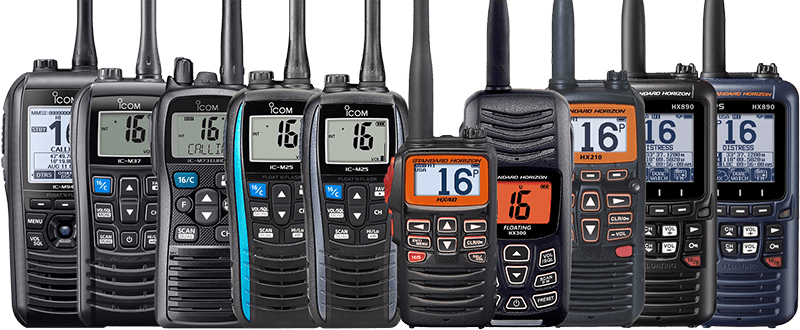
From simple communication devices, VHF radios have evolved into complex equipment. We now have models that have built in GPS, DSC, AIS, voice recording and even Bluetooth! In this guide we will be discussing handheld VHF radios, although it is important to know that they are not the only type.
What are the different types of VHF?
There are two main types of VHF radio. Either fixed mounting or handheld.
Fixed Mounting
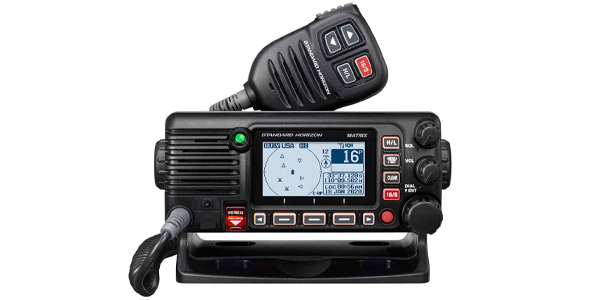
This is usually the main VHF for the vessel. It is mounted in the vessel and wired up to a power source (usually 12v) and a VHF antenna. Fixed radios have 25 watts of power and are capable of broadcasting over a considerable distance. See our range of fixed VHF marine radios.
Handheld
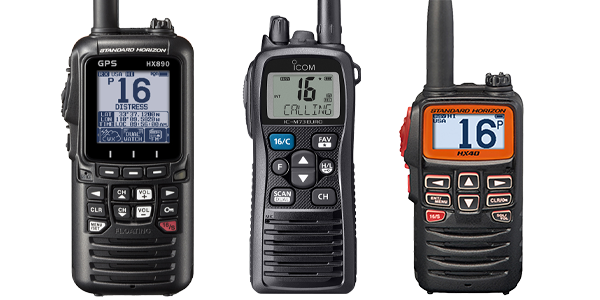
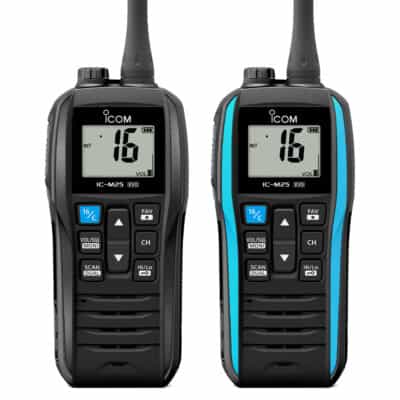
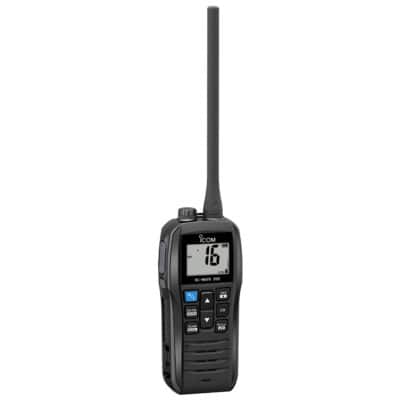
These radios are portable and have their own internal battery / antenna. Handheld radios have up to 6 watts of power and are suitable for short range use. They are ideal for vessels that do not have power, water sports or just to keep on your person. See our range of handheld VHF radios.
What range can I expect from a handheld VHF?
Understanding realistic range expectations helps you use your handheld VHF effectively and know its limitations.
Typical UK Coastal Ranges:
Handheld-to-Handheld: 3-5 nautical miles in open water, reducing to 1-2 miles around headlands or in harbours
Handheld-to-Fixed VHF: 8-12 nautical miles in good conditions, up to 15 miles with clear line of sight. Reduced to 5-8 miles in poor weather or with coastal obstructions.
Handheld-to-Coastguard: 15-20 nautical miles along UK coast, extending to 25+ miles from high coastal stations.
A number of factors impact the range of your radio, and are similar to what you’d expect of a normal radio. These include: antenna height – VHF is line-of-sight so holding the radio higher improves the range; weather – rain, fog and rough seas can all impact your signal; obstructions like cliffs, headlands, and large vessels that can all block signals; and your battery level, where a weak battery reduces your transmitting power.
For a practical example: a sailor 8 miles offshore with a handheld on high power can reliably contact vessels with fixed VHF, marinas or the coastguard. For handheld-to-handheld radio between dinghies, expect a reasonable range of 2-3 miles.
These limited ranges are why you should never just rely on a handheld VHF for offshore passages. Use a fixed VHF radio as your primary device with the handheld as backup.
Which Handheld VHF Radio is best for me?
This answer will depend greatly on the type of boating or activity you are using the radio for.
In terms of just communication, most handheld VHF radios do same thing. You transmit by pressing the push to talk (PTT) button and you can hear others transmitting on selected channels. What really set the radios apart are the additional features and specifications.
It is these specifications below that will determine the best radio for you.
Floating
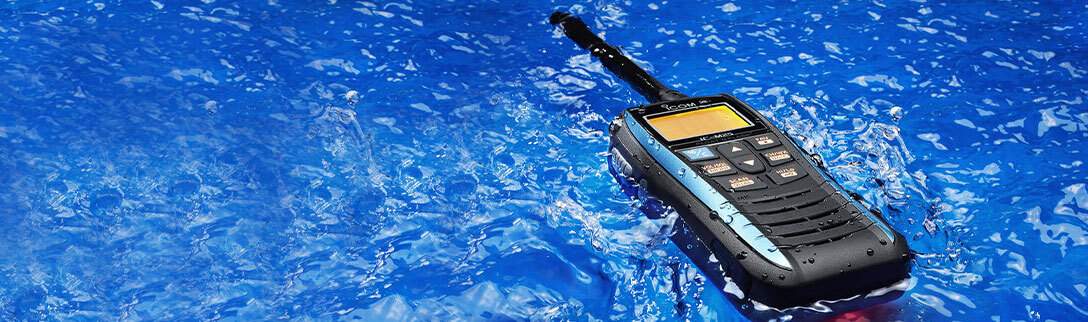
Many radios can now float. Some even have lights that flash once dropped into the water to aid retrieval. This function is ideal for a wide of range of activities, especially water sports where you are likely to be more active with a greater chance of dropping the radio. Floating radios are a bit bigger than non-floating radios due to the space needed for buoyancy chambers.
Floating radios can be found HERE
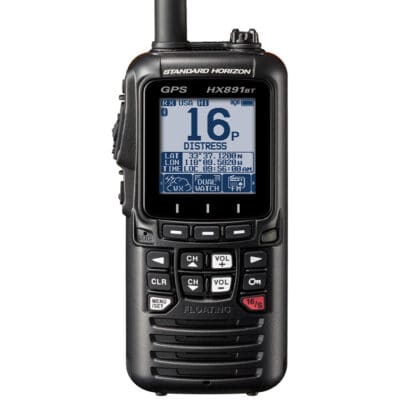
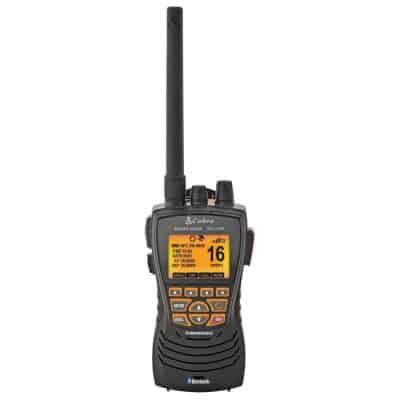
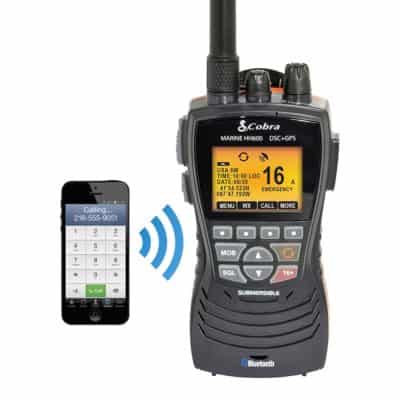
DSC (Digital Selective Calling)
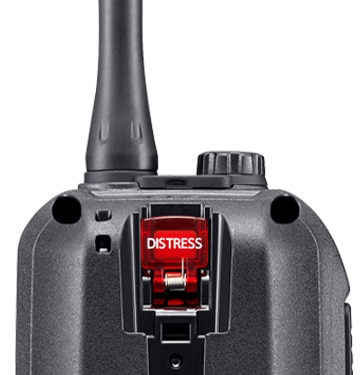
Digital Selective Calling is a way of sending an individual call to another VHF user or to send an automatic distress message. DSC radios have a dedicated distress button that once pressed will send a distress signal to all vessels within range. VHFs that have DSC will also have a GPS receiver built in. To operate a DSC radio, you will need to have an MMSI number either personal or for the vessel (See further down the page for more details).
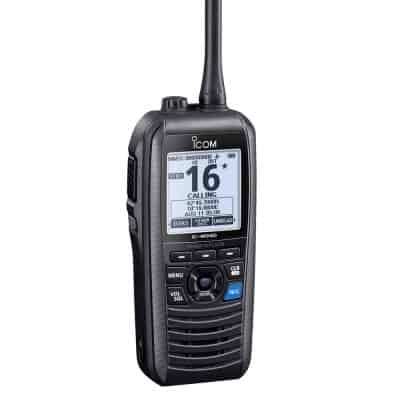
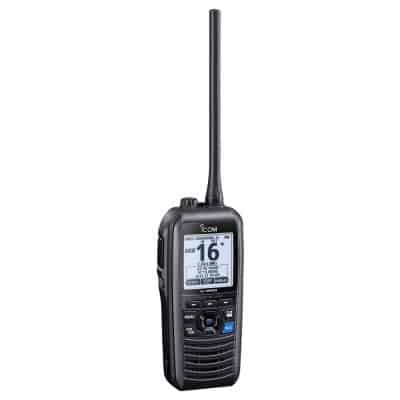
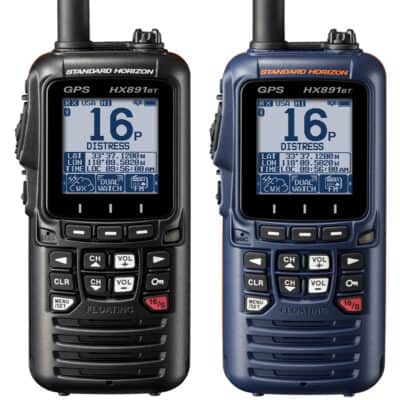
Example of DSC radios are: Icom M94DE, Standard Horizon HX891BT or Cobra HH600


40%
OFF
OFF
AIS Receiver
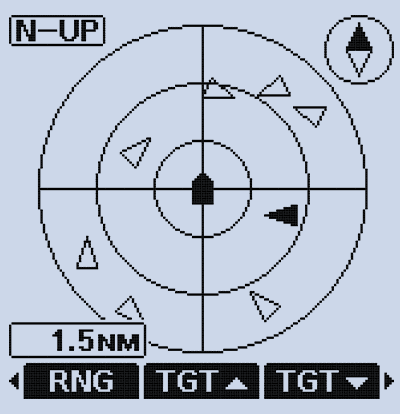
Automatic Identification System (AIS) is an automatic tracking system designed to aid in collision avoidance. The system consists of transponders and receivers which plot vessel locations on a display.
All commercial vessels over 300 tonnes and passenger vessels are required to transmit their location through a class A transponder. Leisure vessels are also able to transmit their location via a class B transponder if they wish.
The Icom M94DE is the world’s first marine VHF handheld radio with an integrated AIS receiver. This shows both class A and B vessels plotted around your current position.
Voice Recording
Some radios can even record the last transmission received. This will stop you from missing an important message or asking the sender to repeat themselves.
Radios with this feature are the Icom M73 Plus and Cobra HH600.
Additional Features
Whilst the above are the main features that will help you decide which radio to purchase, there are a few other specifications you will see while you are shopping.
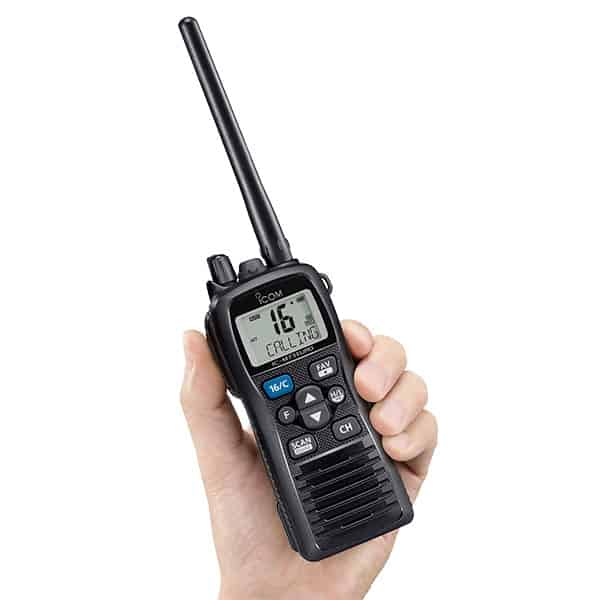
Wattage (Transmitting Power)
The wattage of a radio refers to its transmitting power. In theory the higher the number, the further the transmitting range of the VHF. As a rule of thumb 1 watt = 1 Nautical Mile assuming there are no obstructions. Most radios have a selectable wattage, usually Low/High. This is useful when you are only transmitting over a short distance as it saves power and won’t block other users a few miles away using the same channel.
Most Handheld VHF radios have a maximum of 5 or 6 watts.

Battery Capacity / Technology
The capacity on most batteries is measured in milliampere hours (mAH). Normally the higher the capacity, the longer the device will last, although this is dependent on environmental factors and the internal circuitry of the device.
The technology used in batteries has improved drastically over the last ten years. There was a time when all handheld VHF radios were powered by Nickel-cadmium (Ni-Cad). These suffered from what they call ‘memory effect’ where if the battery wasn’t completely drained before recharging it would remember the shortened charge cycle and reduce the batteries capacity.
We now have Lithium Ion batteries which are smaller, have higher capacity and do not suffer from the ‘memory effect’. This means you can top up the battery at any time to keep it fully charged and ready when you need it most.
Waterproofing / IP Rating
Most handheld VHF radios are waterproof and this is measured with an ‘IP’ rating. This stands for International protection or sometimes referred to as Ingress protection. It is represented by the letters IP followed by two alphanumeric characters. The first is the dust rating which doesn’t often apply on marine products so is usually represented with an ‘X’. The second is for liquid ingress which is detailed below.
(All the handheld radios we sell conform to IPX7 or IPX8 which makes them not only waterproof but submersible up to 1m depth).
1 – Dripping water – Dripping water (vertically falling drops) shall have no harmful effect.
2 – Dripping water when tilted up to 15° – Vertically dripping water shall have no harmful effect when the enclosure is tilted at an angle up to 15° from its normal position.
3 – Spraying water – Water falling as a spray at any angle up to 60° from the vertical shall have no harmful effect.
4 – Splashing water – Water splashing against the enclosure from any direction shall have no harmful effect.
5 – Water jets – Water projected by a nozzle (6.3mm) against enclosure from any direction shall have no harmful effects.
6 – Powerful water jets – Water projected in powerful jets (12.5mm nozzle) against the enclosure from any direction shall have no harmful effects.
7 – Immersion up to 1m – Ingress of water in harmful quantity shall not be possible when the enclosure is immersed in water under defined conditions of pressure and time (up to 1 m of submersion).
8 – Immersion beyond 1m – The equipment is suitable for continuous immersion in water under conditions which shall be specified by the manufacturer. Normally, this will mean that the equipment is hermetically sealed. However, with certain types of equipment, it can mean that water can enter but only in such a manner that it produces no harmful effects.
Choosing the Right Handheld VHF for your activity:
Coastal sailing and cruising – essential features include DSC with GPS for distress alerting, floating design and a 5 – 6W power. Voice recording and AIS receivers add valuable collision avoidance and message playback capabilities.
Dinghy sailing and racing – Prioritise floating design, waterproof rating (IPX7 minimum), and lightweight construction. Low power setting (1W) saves battery and avoids blocking channels. Basic models without DSC suit supervised waters with safety boats.
Fishing (inshore or offshore) – DSC with GPS is essential alongside floating and robust build. Voice recording prevents missing marina instructions, while high battery capacity handles long days monitoring multiple channels.
RIBs and powerboats – Focus on floating, IPX8 waterproofing, and secure clip attachment. DSC with GPS and simple operation with gloves are crucial for high-speed spray conditions.
Kayaking and paddlesports – Compact, floating, and lightweight designs are essential. Basic DSC models with secure pouches suit calm waters near shore where space and weight are at premium.


Which Brands are Trusted for UK waters?
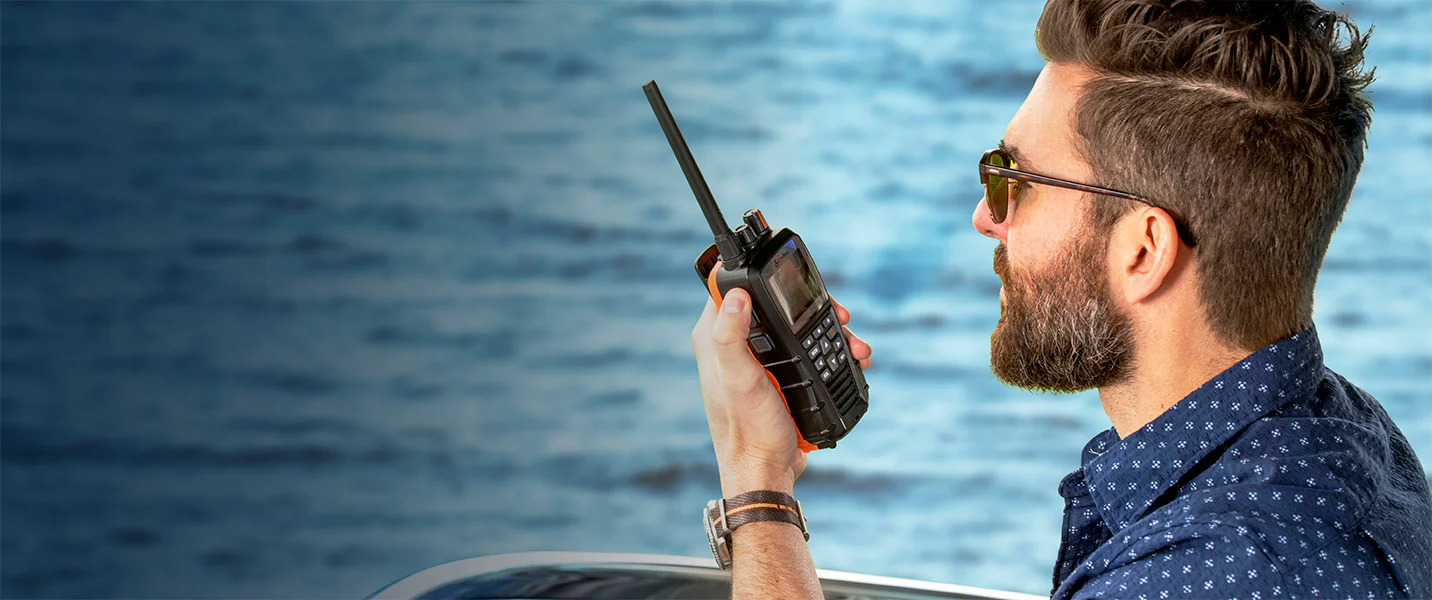
Several handheld VHF brands have earned strong reputations among UK sailors, endorsed by sailing schools and training bodies.
Icom is widely used by RYA training centres and considered highly reliable. Models like the M94DE (with AIS) and M73 Plus are popular for their build quality and feature sets.
Standard Horizon is another favourite of UK sailing schools and professional sailors, endorsed by sailing schools and professional users. Known for intuitive interfaces and robust waterproofing, the HX891BT/E is frequently recommended for serious coastal sailors.
Cobra offers good value with solid performance. The HH600 provides DSC and voice recording DSC and voice recording at competitive price points.
We have a handheld VHF for every budget, activity and skills set. When choosing a brand, consider parts and service availability: major brands have established UK service networks as well as compatibility with equipment you may have used during RYA training.
What are the legal requirements for using a VHF radio?
What are the legal requirements for using a VHF radio?
Any device that broadcasts a radio signal from medium to ultra high frequency will require a license to operate. This is essential for all VHF radios. Licensing ensures that radio equipment used on board ships does not cause undue interference to other communications equipment and is operated by competent persons.
In the UK licensing is controlled by OFCOM and more information can be found using the link below.
https://www.ofcom.org.uk/manage-your-licence/radiocommunication-licences/ships-radio
You will also need a marine radio short range certificate (SRC). This is the minimum qualification required by law to control the operation of VHF and VHF DSC equipment.
This certificate involves attending a course either in person or online followed by an exam. More information can be found using the link below to the RYA website.
https://www.rya.org.uk/training/courses/marine-radio-short-range-certificate-course-srcc
What is an MMSI number?
An MMSI (Maritime Mobile Service Identity) is a unique 9-digit identification number for your vessel or personal radio, essential for using DSC features. When you press the DSC distress button, your MMSI transmits your identity and GPS position to all nearby vessels and the coastguard. Without an MMSI, you cannot send DSC distress alerts.
When you apply to your OFCOM for your license, your MMSI is included. Once you have your MMSI, it must be programmed into your DSC radio following the manufacturers instructions.
Watch our video on how to apply ->
Browse Our VHF Range
By type:
- Handheld VHF radios– Portable communication for all marine activities
- Mounted (Fixed) VHF radios– Permanent installation for vessels with power
Complete your setup:
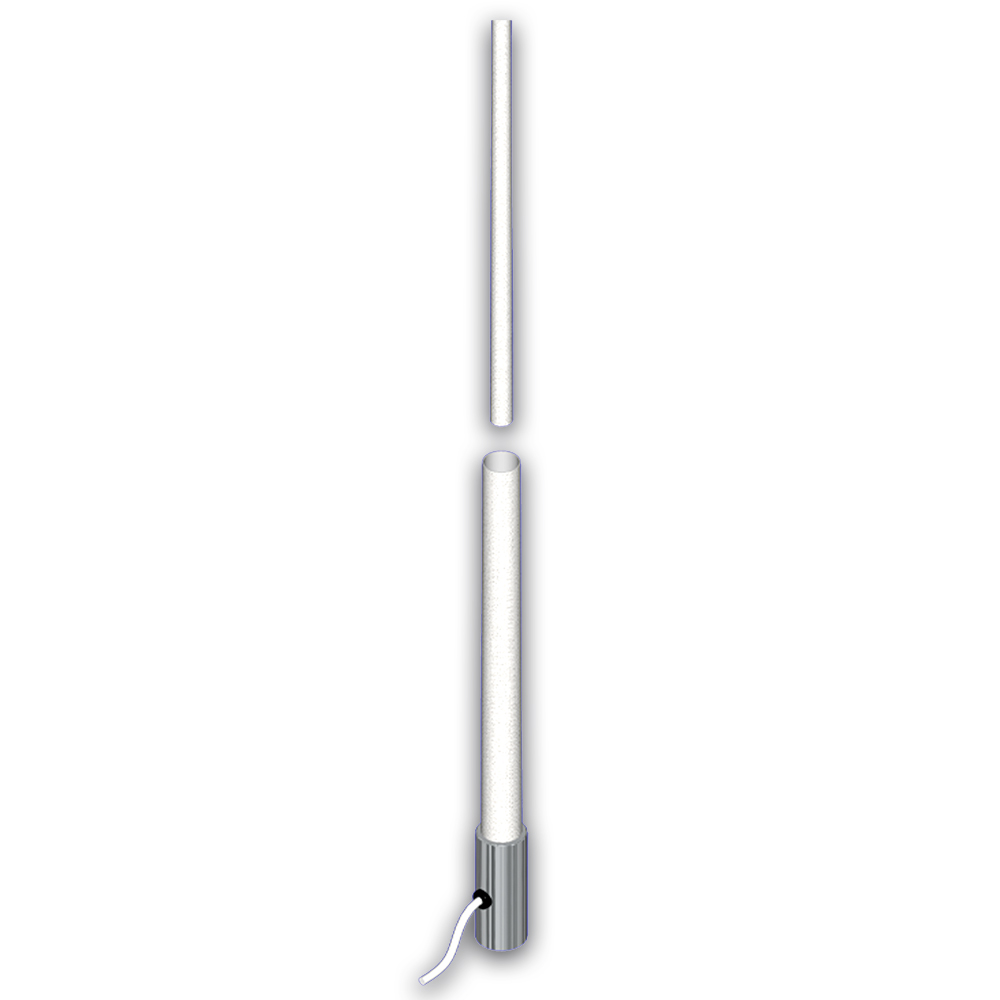
- VHF antennas– Improve range
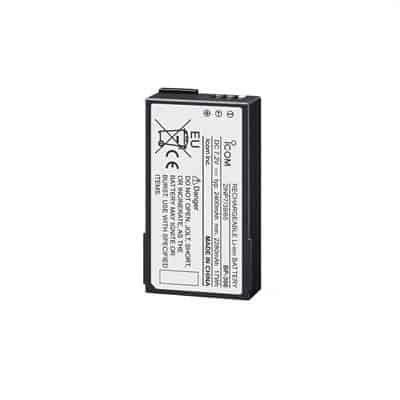
- VHF batteries and accessories– improve performance
- Browse all our marine communication equipment – VHF, AIS, satellite systems
The key factors? Choose a radio with DSC for safety, ensure genuine waterproofing (IPX7+), and match features to your own boating activities.
£444.95
Customer Favourites
40%
OFF
OFF
Here is all you VHF FAQ's answered:
What range can I expect from a handheld VHF radio?
Handheld-to-fixed VHFs typically achieves 8-12 nautical miles in good conditions, up to 15 miles in good circumstances. Handheld-to-handheld range is 3-5 miles in open water, reducing to 1-2 miles around obstacles. Range to Coastguard stations with high antennas can reach 15-20 miles along the UK coast.
Do I need a licence to use a handheld VHF radio?
Yes. In the UK you need both a Ship Portable Radio Licence from OFCOM and a marine radio Short Range Certificate (SRC) qualification. The SRC involves a course and exam through the RYA or approved training centres. These ensure safe, legal operation of VHF equipment.
What is DSC and do I need it?
Digital Selective Calling (DSC) allows you to send automatic distress alerts with your GPS position to all vessels in range. It's essential for coastal and offshore sailing where emergency communication could save your life. DSC radios require an MMSI number to operate, obtained through OFCOM with your radio licence.
Should I choose a floating handheld VHF?
Yes, especially for active water sports, dinghy sailing or fishing. Floating radios are slightly larger due to buoyancy chambers but prevent loss if dropped overboard. Many feature flashing lights when in water to aid retrieval. Even for deck-use on larger vessels, floating designs provide valuable peace of mind.
Which handheld VHF brands are most reliable for UK waters?
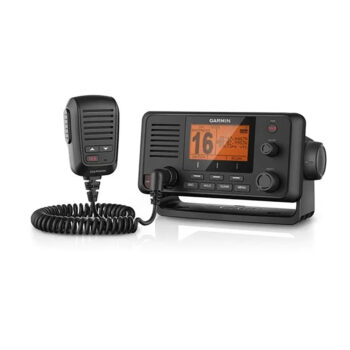
Icom, Standard Horizon & Cobra are widely trusted by UK sailors and RYA training centres. Icom & Standard Horizon are particularly common in sailing schools and charter fleets. Raymarine and Garmin also supply commercial operators, and stock fixed VHFs. Keep in mind, choosing a brand with established UK service networks and dealer support means it will be easier to get parts and advice within the community.
What's the difference between 1W and 6W transmit power?
Higher wattage extends range - roughly 1 watt per nautical mile. Most handhelds offer 5-6W maximum. Use high power (5-6W) for long-range communication or emergencies. Use low power (1W) for short-range communication to save battery and avoid blocking the channel for distant users.